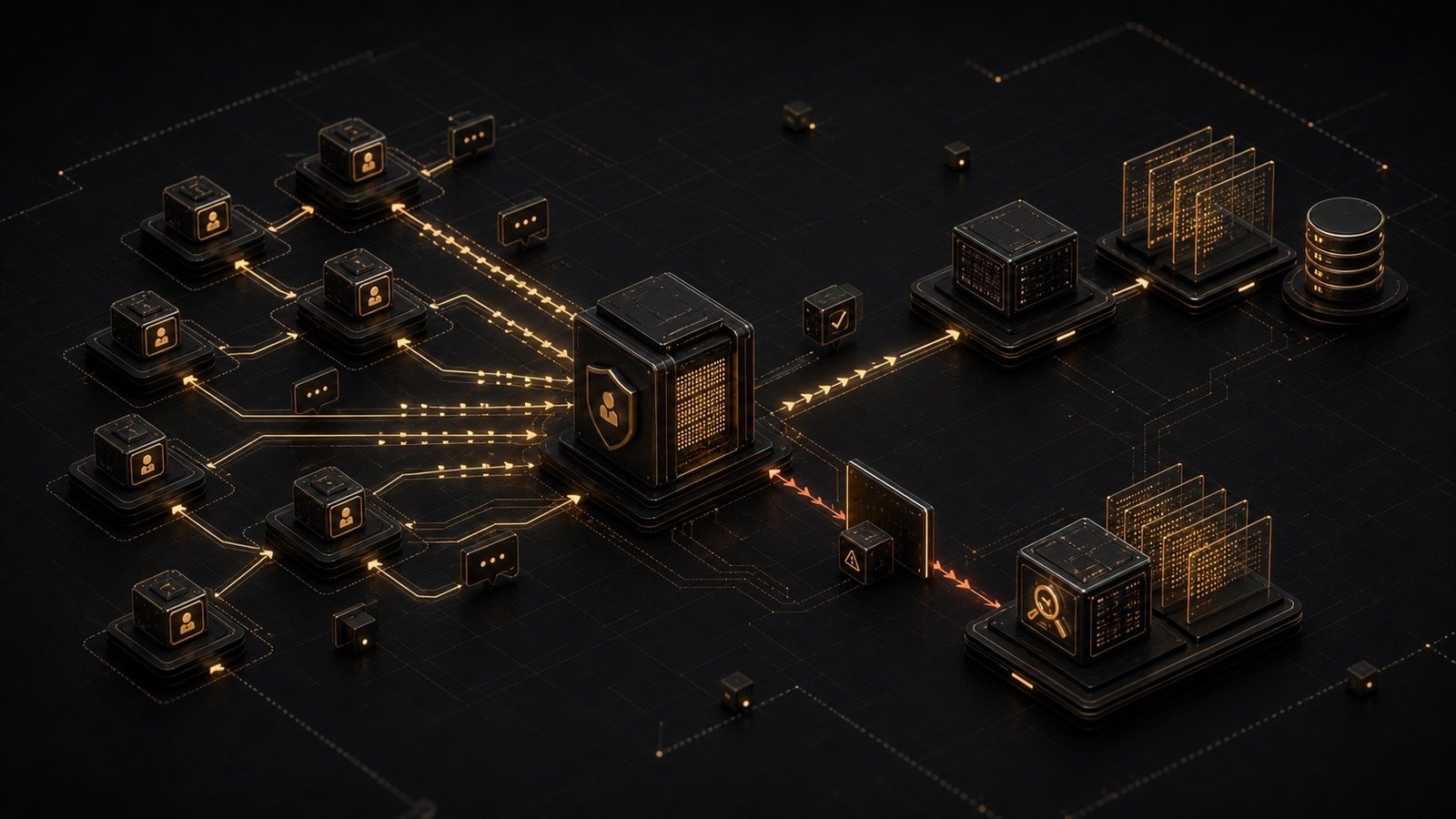
Your AI agents make thousands of LLM calls a day. Reading your email. Querying your databases. Writing your code. Talking to your customers.
Now answer one question: what did they say?
Not roughly. Exactly. Which prompts went out, which responses came back, and what was inside them. If you can't answer that, you have a blind spot - and it sits directly on top of your most sensitive data.
I've Seen This Before
I spent thirteen years in cybersecurity at a global bank, much of it building data loss prevention. The premise of DLP is simple: people handle sensitive data, people make mistakes, so you inspect what leaves the boundary. We built systems that watched every channel an employee could use to move data - email, web, removable media - because we knew that trust without inspection is just hope.
Then I started running AI agent fleets, and I noticed something uncomfortable.
At MIOCONSULT we run six different coding agents behind a hardened CI/CD pipeline. Every line of code they produce passes eight-plus security gates before it ships - static analysis, dependency scanning, secret detection, signing. Nothing reaches production until it's been verified. That's the rule, and the pipeline enforces it.
But the agents' conversations - the actual prompts and responses flowing between them and their models, all day, every day - passed through no gate at all. The most active channel in the building was the only one nobody was watching.
That's the agent blind spot. An employee's outbound email gets inspected. An agent's outbound prompt - which may carry the same credentials, the same customer records, the same internal architecture - does not.
What Passes Through
If you've never inspected agent traffic, here's what you're not seeing:
- Prompt injection - content the agent ingested (a web page, an email, a document) that quietly rewrites its instructions
- Credential leaks - API keys, private key material, environment variables, and database connection strings riding along in context windows
- Wallet-draining loops - an agent stuck retrying an expensive operation, burning tokens for hours before anyone notices
- Jailbreaks - patterns designed to talk a model out of its constraints, arriving through channels you don't control
And when something does go wrong, the second problem appears: no evidence. Without an immutable record of what was actually said, an incident isn't an investigation - it's a reconstruction exercise. I've run enough incident response to know the difference. Reconstruction is where confidence goes to die.
So I Built the Missing Layer
ClawNex is a real-time Security Operations Center for AI agent fleets. It drops in between your agents and their models as an OpenAI-compatible proxy. Every request and every response passes through it - and gets inspected before the model ever sees it.
The core is a shield engine: 163 detection rules across 10 threat categories - secret exfiltration, command injection, jailbreak patterns, C2 beacons, steganography, encoding attacks, trust exploitation, and more. Each scan produces a score-based verdict: ALLOW, REVIEW, or BLOCK. Blocking happens pre-call - a detected threat is rejected before it reaches the model, not flagged after the damage is done.
Two design decisions matter more than any feature list:
- Fail-closed. If the shield can't inspect traffic, traffic doesn't move. A security layer that fails open is a decoration.
- Observe first, enforce when ready. You start in observe mode - full visibility, no disruption - and turn on enforcement when you trust the verdicts. Security you can't roll out gradually is security nobody deploys.
Data Loss Prevention, Both Directions
This is the part that brings my career full circle. ClawNex ships a starter Shield/DLP policy framework - curated starter packs plus rules you write yourself:
- Outbound leak detection - private keys, password assignments, environment-variable leaks, internal IPs, and database connection URIs caught in model responses before they leave your boundary
- PII detection and auto-redaction - emails, phone numbers, SSNs, credit cards, dates of birth, passport numbers - with span-based redaction that scrubs the match without destroying the message
- Operator-authored rules - write your own detection patterns, group them under named policies, test them against sample payloads in the dashboard, and enforce them at the wire with the same engine that drives the built-in rules
And one guarantee I insisted on: scan-equals-forward. The exact bytes the shield scans are the exact bytes forwarded upstream. Nothing rides along uninspected.
From Signals to Stories
A single BLOCK is noise. A BLOCK plus an infrastructure spike plus a configuration change is a coordinated attack. ClawNex's correlation engine aggregates signals across shield scans, traffic, infrastructure, and access events into scored incidents with recommended actions.
Then Mission Control turns every incident into a guided investigation: a five-stage triage graph - Evidence, Source Event, Affected Object, Related Activity, Fix - across nine signal families, from CVE exposure to policy drift. The goal is simple: when your auditor or your client asks "what happened?", you answer with a narrative backed by immutable evidence, not a shrug backed by grep.
The audit layer is built in, not bolted on: a tamper-evident trail with four-tier event labeling, scheduled compliance reports, SOC 2 and ISO 27001 evidence templates, and CVE-to-shield mapping that shows exactly which rules cover which vulnerability classes.
Why Open Source
I built ClawNex because smaller organizations and independent operators should not need an enterprise security budget before they can put meaningful controls around an AI agent. It is not presented as a replacement for a mature enterprise security platform. It is a practical, self-hosted layer that brings some of the same useful ideas - traffic inspection, operator-authored DLP rules, PII protection, prompt-injection and jailbreak detection, and evidence - within reach without a licence fee.
This is also a way of giving something back. I have spent about 30 years securing systems. Agent harnesses are the tools people are adopting now, so I wanted to package that experience around the risks those tools create and make it available to anyone who has a genuine need for it. ClawNex runs under the operator's control, close to the harness and the data it is protecting.
ClawNex is Apache 2.0. Self-hosted. The entire control plane is auditable, forkable, and deployable in air-gapped environments. Baseline security - RBAC with 5 roles and 32 permissions, CSRF protection, progressive lockout, session governance, supply-chain pinning - is included, not sold back to you as a premium tier.
This wasn't a business-model afterthought. It's the same principle that runs through everything I write here: trust is built through verification, not promises. A security tool you can't inspect is itself a trust exercise - you'd be patching one blind spot with another. If ClawNex is going to sit on the most sensitive traffic in your infrastructure, you should be able to read every line of what it does.
Your infrastructure. Your data. No SaaS meter running.
That same logic belongs in the wider Groovefellows Stack film and operating-pattern case study around the agents: identity, documentation, observability, and recovery should be inspectable too.
The Question to Ask This Week
You don't need ClawNex to act on this article. Start with the question it was built to answer:
What did your agents say today - and how do you know?
If the answer is "I'd have to check the provider's billing page," you've found your blind spot. Inspect it before someone else does.
ClawNex is live at clawnexai.com - one nexus, total control.
Running agents in production and want a second pair of eyes on your setup? Let's talk.